
Thanksgiving is right around the corner.
And if you're anything like me...
YOU LOVE TO EAT!
Trust me. I do too.
But here's something you might not know about me.
I've battled my weight for most of my life.
And every holiday season, I used to find myself falling into the same trap.
Thanksgiving would arrive, I'd enjoy an incredible meal, and before I knew it, one day of celebrating had turned into six weeks of eating.
Then January would come around, and I'd be trying to lose weight all over again.
Until I discovered intermittent fasting.
And for me, it changed everything about how I organize my eating.
In today's blog, I'm sharing my lifelong battle with weight, how I discovered fasting, three popular approaches to intermittent fasting, and how I organize my strength training while following OMAD — One Meal a Day.
I'll also share five strategies I use to navigate Thanksgiving and the holidays without abandoning the habits I've worked hard to build.
Because here's something I want you to remember.
THANKSGIVING IS ONE DAY. DON'T LET IT TURN INTO SIX WEEKS OF BAD HABITS.
THE GOLFER'S MYTH — "I'LL JUST START AGAIN IN JANUARY"
You know what I hear every holiday season?
"I'll just start again in January."
And that's exactly why so many people join gyms after New Year's.
But here's my advice.
DON'T BECOME A NEW YEAR'S RESOLUTIONER!
Especially if you're a golfer.
Because golfers...
THE OFFSEASON HAS ALREADY STARTED.
Think about your golf game.
Imagine spending six weeks practicing bad swing habits.
Then suddenly deciding you want to improve.
Now you're not just learning something new.
YOU'RE TRYING TO UNDO SIX WEEKS OF BAD HABITS.
Your health and fitness are no different.
Enjoy Thanksgiving.
Enjoy Christmas.
Enjoy the holidays.
But don't spend six weeks moving farther away from your goals.
Build your foundation now so January becomes a continuation of your progress — not another starting line.
SECTION 1 — MY LIFELONG BATTLE WITH WEIGHT
All right, golfers.
Let me tell you a dirty little secret about myself.
I WAS DIAGNOSED AS CLINICALLY OBESE AT THE AGE OF 12.
And I've spent the last 34 years battling weight gain, weight loss, and yo-yo dieting.
I've tried just about everything.
Back in the 1990s, it was low-fat diets, SlimFast, and calorie restriction.
Then came the early 2000s.
Atkins.
Low-carbohydrate diets.
And later, I dove into keto, carnivore, and counting calories.
You name it.
I TRIED IT.
And to be fair, some of these approaches worked.
At least for a while.
But eventually, I'd find myself right back where I started.
Because here's the thing.
I LOVE EATING!
Food makes me happy.
I love sitting down to a substantial dinner.
And Thanksgiving?
THAT'S MY FAVORITE MEAL OF THE YEAR!
I'm all in.
But for years, Thanksgiving was the beginning of a six-week eating marathon.
And January would arrive with me trying to lose weight all over again.
Even though I've spent my career working in fitness, I'd become exactly what I told my clients not to become.
A New Year's resolutioner.
Eventually, I started looking for something different.
And that's when I discovered intermittent fasting.
HOW I DISCOVERED FASTING
I've never been a big breakfast person.
I'd typically eat lunch around noon and dinner around six.
And that was pretty much it.
But I noticed something.
After eating a substantial lunch, I'd sometimes feel sluggish.
And when you're working with clients all afternoon...
THE LAST THING YOU WANT IS TO FEEL LIKE TAKING A NAP!
So I started learning more about fasting.
I came across Kyle Newell's Panda Diet approach and began experimenting with different eating windows.
Eventually, I discovered OMAD.
ONE MEAL A DAY.
And for my lifestyle?
IT WAS A GAME CHANGER!
I could work throughout the day, focus on my clients, get my workouts in, and enjoy a huge dinner in the evening.
And best of all?
I found that I could maintain my workouts while following this eating schedule.
For the first time, I had an eating structure that worked for me.
FASTING DIDN'T TAKE AWAY MY LOVE OF FOOD. IT GAVE ME A WAY TO ORGANIZE IT.
SECTION 2 — FASTING 101: THREE APPROACHES TO UNDERSTAND
All right, golfers.
Let's make fasting simple.
There are plenty of approaches out there, but I want to focus on three.
12:12 fasting.
16:8 fasting.
OMAD — One Meal a Day.
And remember...
FASTING ISN'T ABOUT SEEING HOW LONG YOU CAN STARVE YOURSELF.
It's about creating structure and consistency.
NUMBER ONE — 12:12 FASTING
Twelve hours fasting.
Twelve hours eating.
This is probably the simplest place to start.
Here's an example.
You finish dinner around 7:00 PM.
You don't eat again until 7:00 AM.
Congratulations!
You've just completed a 12-hour fast.
For many people, this is similar to the overnight fast they complete before routine blood testing.
But here's why I like it as a starting point.
It creates a defined eating window and may help eliminate late-night snacking.
And for some people, that's already a big improvement.
The goal isn't necessarily to make your fasting window longer every day.
It's to establish a routine you can maintain.
NUMBER TWO — 16:8 FASTING
Now we're extending the fasting window.
Sixteen hours fasting.
Eight hours eating.
Here's an example.
You finish dinner at 8:00 PM.
You don't eat again until noon the following day.
Now you have an eight-hour window to consume your meals.
This was one of the approaches I experimented with before moving to OMAD.
I liked having a defined eating window.
But I still found myself sometimes overeating.
And at other times, I felt like I was trying to restrict calories throughout the day.
That wasn't the structure I wanted.
For me, the bigger question became...
Could I find an eating schedule that allowed me to enjoy a substantial dinner without constantly thinking about food?
And that's what led me to OMAD.
NUMBER THREE — OMAD: ONE MEAL A DAY
Now we're getting into what I personally do.
OMAD — ONE MEAL A DAY.
For me, that typically means approximately 22 hours of fasting followed by a two-hour eating window.
I work throughout the day.
Get my workouts in.
Then sit down and enjoy a substantial dinner.
AND BELIEVE ME, I ENJOY DINNER!
One of my favorite things about OMAD is that I can eat a satisfying meal without feeling like I'm constantly restricting myself throughout the day.
But here's another thing.
I don't necessarily sit down and eat everything at once.
I treat my two-hour eating window almost like going to a restaurant.
I'll start with something small.
An appetizer.
Then a little later, I'll enjoy my main meal.
And afterward?
Maybe some dessert.
All within that eating window.
For my lifestyle, this structure has worked extremely well.
But I want to make something clear.
OMAD IS WHAT WORKS FOR ME. THAT DOESN'T MEAN EVERYONE NEEDS TO FOLLOW IT.
Eating one meal a day can make it difficult to consume enough calories, protein, fiber, and essential nutrients, especially for people who exercise regularly.
If you're experimenting with fasting, a shorter overnight fasting schedule may be a better place to begin.
Consistency and adequate nutrition matter more than reaching a particular fasting duration.
WHAT HAPPENS INSIDE YOUR BODY WHEN YOU FAST?
Here's where things get interesting.
Every time you eat, especially carbohydrates, insulin helps regulate blood glucose and nutrient storage.
As time passes without eating, insulin levels generally decline.
And your body increasingly relies on stored energy, including fat.
That's one reason people become interested in intermittent fasting.
It creates longer periods between meals when the body isn't processing newly consumed food.
But it's important to understand that fasting doesn't automatically guarantee fat loss.
Your overall energy intake, food quality, activity, and consistency still matter.
WHAT ABOUT AUTOPHAGY?
Now let's talk about something I find fascinating.
AUTOPHAGY.
Think of autophagy as your body's cellular recycling system.
It's a natural process in which cells break down and recycle damaged or unnecessary components.
And fasting may influence this process.
You'll hear people discuss extended fasting periods, sometimes lasting several days, in connection with autophagy.
However, research hasn't established a specific fasting duration that reliably produces particular autophagy benefits in humans.
Longer fasts also carry additional risks and shouldn't be treated as automatically healthier.
For me, the biggest practical benefit of fasting has been much simpler.
STRUCTURE.
And that's what has helped me manage my eating.
A quick note: I'm sharing my personal experience, not prescribing a diet. Fasting isn't appropriate for everyone. If you have diabetes, take blood sugar medications, have a history of eating disorders, or have other medical concerns, talk with a qualified healthcare professional before starting. Extended fasting should not be attempted without appropriate medical guidance.
SECTION 3 — CAN YOU LIFT HEAVY WEIGHTS WHILE FASTING?
This is one of the biggest questions I get.
CAN YOU ACTUALLY LIFT HEAVY WEIGHTS WHILE FASTING?
My answer?
YES!
I've personally been following an OMAD approach for over a year, and I've learned how to organize my training around it.
But how someone performs while fasting varies.
Training intensity, hydration, total calorie intake, protein consumption, and recovery all matter.
Here's what I do.
WHEN I'M PLANNING A HEAVIER WORKOUT
Let's say I start eating around six in the evening and finish around eight.
If I know I'm planning a heavier workout the following morning, I may adjust my meal to include more carbohydrates.
That can help support muscle glycogen availability for training.
Then I'll work out around eight or nine the next morning.
I've eaten the night before.
I've slept.
And I generally feel ready to lift.
Especially if I'm going after a personal record.
I WANT TO FEEL STRONG AND READY TO PERFORM.
CAN I TRAIN LATER IN THE DAY?
Absolutely.
Over time, I've become more comfortable training later in my fast.
In fact, over the last several months, I've increasingly preferred lifting later in the afternoon.
Sometimes around one or two.
Sometimes even later.
And I can still lift pretty heavy.
Then, after my workout, I'll break my fast around five or six.
That schedule works extremely well for me.
But I didn't start out this way.
It took time to understand how my body responded.
And I continue monitoring three things.
PERFORMANCE — How much weight am I lifting?
ENERGY — How do I feel throughout the workout?
RECOVERY — Am I recovering well enough to train again?
Because even though I'm fasting...
MAINTAINING MUSCULAR STRENGTH IS STILL A HIGH PRIORITY.
WHY I PREFER TRAINING FASTED
Here's something I've learned about myself.
I PREFER WORKING OUT IN A FASTED STATE.
I don't enjoy having a substantial meal sitting in my stomach while I'm lifting.
I feel more comfortable training before eating.
And because I've experimented with my routine over time, I know what generally works for my body.
Now, you'll sometimes hear people claim that exercising after a meal diverts all your blood to digestion.
That's not quite how the body works.
Your circulatory system can support digestion and muscular activity simultaneously.
But large meals can cause gastrointestinal discomfort during intense exercise.
And that's one reason I prefer training without a large meal beforehand.
Exercise also helps improve muscular insulin sensitivity.
Following training, adequate protein and carbohydrates support recovery, muscle protein synthesis, and glycogen replenishment.
For me, the structure is simple.
TRAIN. EAT. RECOVER.
But training fasted isn't automatically superior to training after eating.
The most important thing is finding a routine that supports your performance, nutrition, and recovery.
DON'T FORCE A HEAVY WORKOUT
Here's another thing I want golfers to understand.
Not every workout needs to be a personal record.
If I'm deep into a fast and feeling sluggish, I may adjust my workout.
Reduce the weight.
Focus on controlled repetitions.
Emphasize contraction quality.
Or maybe I'll skip the weights altogether.
Go outside.
Walk for 45 minutes.
Maybe an hour.
Keep moving.
A WORKOUT DOESN'T HAVE TO DESTROY YOU TO BE PRODUCTIVE.
The goal is maintaining consistency while supporting muscular strength and recovery.
SECTION 4 — FIVE WAYS TO NAVIGATE THANKSGIVING & THE HOLIDAYS
Let's bring everything together.
Thanksgiving is coming.
And with it comes Christmas parties, holiday gatherings, family dinners, and plenty of opportunities to eat.
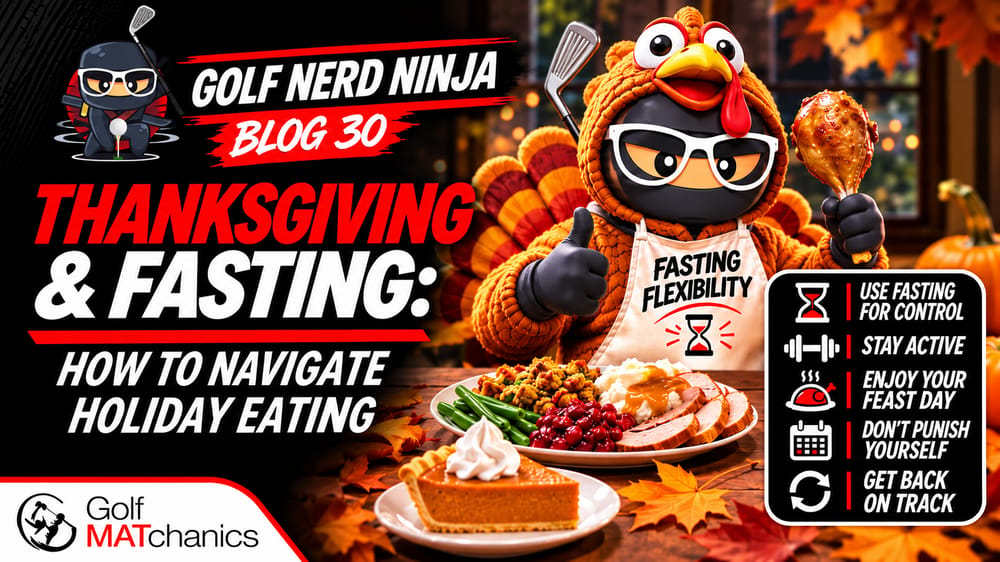
Here are my five strategies for navigating the holidays without letting one day turn into six weeks of bad habits.
NUMBER ONE — THINK ABOUT CONTROL
This is one of the biggest reasons I fast.
FASTING GIVES ME STRUCTURE AND CONTROL OVER WHEN I EAT.
I have a defined eating window.
I know when I'm going to sit down and enjoy my food.
And I'm not constantly eating throughout the day.
Because Thanksgiving is one day.
THE PROBLEM IS WHEN ONE DAY TURNS INTO SIX WEEKS OF NONSTOP EATING.
For me, fasting helps maintain my structure.
It's not about starving myself so I can eat everything in sight.
It's about developing a routine that gives me flexibility when special occasions come around.
NUMBER TWO — STAY ACTIVE
Listen, the holidays get busy.
Family gatherings.
Shopping.
Parties.
Travel.
I get it.
But don't let that become an excuse to stop moving.
TRY TO MAINTAIN YOUR REGULAR WORKOUT SCHEDULE.
If that's three or four days a week, do your best to keep it going.
Even if you only have 30 minutes.
Get into the gym.
Lift some weights.
Go for a walk.
Do something.
Maybe you can't get your normal hour-long workout in.
That's fine.
THIRTY MINUTES OF ACTIVITY IS BETTER THAN ABANDONING YOUR ROUTINE ALTOGETHER.
And golfers...
Remember that the offseason has already started.
This is an opportunity to improve muscular function and develop strength for next season.
NUMBER THREE — ENJOY YOUR FEAST DAY
Now this is my favorite one.
ENJOY THANKSGIVING!
And the same goes for Christmas parties, work gatherings, and family celebrations.
Make that your feast day.
Enjoy the foods you love.
Spend time with your family.
Have your turkey.
Have your stuffing.
Have your mashed potatoes.
And don't feel like you have to sit there eating a salad while everyone else enjoys Thanksgiving dinner.
Because here's one reason I love having a consistent eating routine.
I CAN ENJOY SPECIAL OCCASIONS WITHOUT FEELING LIKE I'VE ABANDONED MY ENTIRE PLAN.
And afterward?
I simply return to my normal schedule.
ONE BIG MEAL DOESN'T ERASE YOUR PROGRESS.
NUMBER FOUR — DON'T PUNISH YOURSELF
You wake up after Thanksgiving.
You're feeling bloated.
Maybe the scale is up.
And you're thinking...
"I need to fast for four days to make up for yesterday!"
NO!
You don't need to punish yourself for enjoying Thanksgiving dinner.
You don't need to add extra fasting hours to compensate.
And you don't need to destroy yourself in the gym.
A temporary increase on the scale can reflect additional food, carbohydrates, sodium, and water retention.
That doesn't automatically mean you've gained that amount of body fat.
JUST RETURN TO YOUR NORMAL ROUTINE.
That's the advantage of having structure.
You're not constantly starting over.
NUMBER FIVE — GET BACK INTO YOUR ROUTINE
Thanksgiving is Thursday.
FRIDAY, GET RIGHT BACK AT IT!
Maybe you go for a walk.
Maybe you do something lighter.
But personally?
I LOVE GETTING A HEAVIER WORKOUT IN AFTER THANKSGIVING.
I've eaten a substantial meal the day before.
And when I say substantial...
I MEAN I ATE MY ASS OFF!
I'm feeling a little fat and jolly.
And I'm ready to lift some heavy weights!
Rather than sitting around feeling guilty about yesterday, I'd rather do something productive today.
Of course, I'll still adjust my workout based on how I'm feeling.
But here's the point.
ENJOY THE HOLIDAY. GET BACK TO YOUR STRUCTURE. KEEP MOVING FORWARD.
THREE TAKEAWAYS FOR GOLFERS
1. BUILD YOUR STRUCTURE
Consider starting with a consistent overnight eating schedule, such as 12:12.
Experiment with an eating window that works for your lifestyle and supports your nutritional needs.
For me, OMAD has been extremely helpful.
But longer fasting windows aren't necessarily better for everyone.
FIND A STRUCTURE YOU CAN MAINTAIN.
2. TRAIN SMART
Organize your workouts around your eating schedule.
Maintain your strength.
Pay attention to energy levels.
And prioritize recovery.
FASTING SHOULD SUPPORT YOUR ROUTINE, NOT CONSTANTLY INTERFERE WITH IT.
3. DON'T WAIT UNTIL JANUARY
Enjoy Thanksgiving.
Enjoy Christmas.
Enjoy the holidays.
But don't let one day turn into six weeks of bad habits.
START BUILDING YOUR FOUNDATION NOW.
FINAL THOUGHTS — FOOD IS FOOD. AND I LOVE EATING!
I've battled my weight for most of my life.
And even after spending decades working in fitness, I've had to find an eating structure that works for me personally.
For me, intermittent fasting has been a lifesaver.
It's helped me organize my eating without feeling like I'm missing out on family dinners, holidays, and special occasions.
I fast.
Then I eat.
And yeah...
I MIGHT GET A LITTLE SLOPPY DURING THE HOLIDAYS!
But having a consistent routine helps keep me in check.
And here's what I want you to remember.
THANKSGIVING IS ONE DAY.
YOUR HEALTH AND FITNESS ARE YEAR-ROUND.
Enjoy the holiday.
Spend time with your family.
Eat some great food.
And get back to your normal routine afterward.
Because the goal isn't perfection.
THE GOAL IS CONSISTENCY.
Happy Thanksgiving, golfers!
Are You Ready to Stop Guessing?
If your body does not feel like it is keeping up with your golf game, start here:
Take the Golf MATchanics™ Golf Body Test.
Want a deeper look at your body and your swing?
Learn more about the Body BluePrint.
Want to understand your strength, force, and golf-body performance? Learn more about the IMPACT BluePrint.
Ready to talk through the best starting point for you?
Book a 30-minute Golf MATchanics™ consultation.
Because golf longevity is not something you hope for.
It is something you build.
Thanksgiving & Fasting: How to Navigate Holiday Eating
Monday, November 23, 2026
Thanksgiving is right around the corner.
And if you're anything like me...
YOU LOVE TO EAT!
Trust me. I do too.
But here's something you might not know about me.
I've battled my weight for most of my life.
And every holiday season, I used to find myself falling into the same trap.
Thanksgiving would arrive, I'd enjoy an incredible meal, and before I knew it, one day of celebrating had turned into six weeks of eating.
Then January would come around, and I'd be trying to lose weight all over again.
Until I discovered intermittent fasting.
And for me, it changed everything about how I organize my eating.
In today's blog, I'm sharing my lifelong battle with weight, how I discovered fasting, three popular approaches to intermittent fasting, and how I organize my strength training while following OMAD — One Meal a Day.
I'll also share five strategies I use to navigate Thanksgiving and the holidays without abandoning the habits I've worked hard to build.
Because here's something I want you to remember.
THANKSGIVING IS ONE DAY. DON'T LET IT TURN INTO SIX WEEKS OF BAD HABITS.
THE GOLFER'S MYTH — "I'LL JUST START AGAIN IN JANUARY"
You know what I hear every holiday season?
"I'll just start again in January."
And that's exactly why so many people join gyms after New Year's.
But here's my advice.
DON'T BECOME A NEW YEAR'S RESOLUTIONER!
Especially if you're a golfer.
Because golfers...
THE OFFSEASON HAS ALREADY STARTED.
Think about your golf game.
Imagine spending six weeks practicing bad swing habits.
Then suddenly deciding you want to improve.
Now you're not just learning something new.
YOU'RE TRYING TO UNDO SIX WEEKS OF BAD HABITS.
Your health and fitness are no different.
Enjoy Thanksgiving.
Enjoy Christmas.
Enjoy the holidays.
But don't spend six weeks moving farther away from your goals.
Build your foundation now so January becomes a continuation of your progress — not another starting line.
SECTION 1 — MY LIFELONG BATTLE WITH WEIGHT
All right, golfers.
Let me tell you a dirty little secret about myself.
I WAS DIAGNOSED AS CLINICALLY OBESE AT THE AGE OF 12.
And I've spent the last 34 years battling weight gain, weight loss, and yo-yo dieting.
I've tried just about everything.
Back in the 1990s, it was low-fat diets, SlimFast, and calorie restriction.
Then came the early 2000s.
Atkins.
Low-carbohydrate diets.
And later, I dove into keto, carnivore, and counting calories.
You name it.
I TRIED IT.
And to be fair, some of these approaches worked.
At least for a while.
But eventually, I'd find myself right back where I started.
Because here's the thing.
I LOVE EATING!
Food makes me happy.
I love sitting down to a substantial dinner.
And Thanksgiving?
THAT'S MY FAVORITE MEAL OF THE YEAR!
I'm all in.
But for years, Thanksgiving was the beginning of a six-week eating marathon.
And January would arrive with me trying to lose weight all over again.
Even though I've spent my career working in fitness, I'd become exactly what I told my clients not to become.
A New Year's resolutioner.
Eventually, I started looking for something different.
And that's when I discovered intermittent fasting.
HOW I DISCOVERED FASTING
I've never been a big breakfast person.
I'd typically eat lunch around noon and dinner around six.
And that was pretty much it.
But I noticed something.
After eating a substantial lunch, I'd sometimes feel sluggish.
And when you're working with clients all afternoon...
THE LAST THING YOU WANT IS TO FEEL LIKE TAKING A NAP!
So I started learning more about fasting.
I came across Kyle Newell's Panda Diet approach and began experimenting with different eating windows.
Eventually, I discovered OMAD.
ONE MEAL A DAY.
And for my lifestyle?
IT WAS A GAME CHANGER!
I could work throughout the day, focus on my clients, get my workouts in, and enjoy a huge dinner in the evening.
And best of all?
I found that I could maintain my workouts while following this eating schedule.
For the first time, I had an eating structure that worked for me.
FASTING DIDN'T TAKE AWAY MY LOVE OF FOOD. IT GAVE ME A WAY TO ORGANIZE IT.
SECTION 2 — FASTING 101: THREE APPROACHES TO UNDERSTAND
All right, golfers.
Let's make fasting simple.
There are plenty of approaches out there, but I want to focus on three.
12:12 fasting.
16:8 fasting.
OMAD — One Meal a Day.
And remember...
FASTING ISN'T ABOUT SEEING HOW LONG YOU CAN STARVE YOURSELF.
It's about creating structure and consistency.
NUMBER ONE — 12:12 FASTING
Twelve hours fasting.
Twelve hours eating.
This is probably the simplest place to start.
Here's an example.
You finish dinner around 7:00 PM.
You don't eat again until 7:00 AM.
Congratulations!
You've just completed a 12-hour fast.
For many people, this is similar to the overnight fast they complete before routine blood testing.
But here's why I like it as a starting point.
It creates a defined eating window and may help eliminate late-night snacking.
And for some people, that's already a big improvement.
The goal isn't necessarily to make your fasting window longer every day.
It's to establish a routine you can maintain.
NUMBER TWO — 16:8 FASTING
Now we're extending the fasting window.
Sixteen hours fasting.
Eight hours eating.
Here's an example.
You finish dinner at 8:00 PM.
You don't eat again until noon the following day.
Now you have an eight-hour window to consume your meals.
This was one of the approaches I experimented with before moving to OMAD.
I liked having a defined eating window.
But I still found myself sometimes overeating.
And at other times, I felt like I was trying to restrict calories throughout the day.
That wasn't the structure I wanted.
For me, the bigger question became...
Could I find an eating schedule that allowed me to enjoy a substantial dinner without constantly thinking about food?
And that's what led me to OMAD.
NUMBER THREE — OMAD: ONE MEAL A DAY
Now we're getting into what I personally do.
OMAD — ONE MEAL A DAY.
For me, that typically means approximately 22 hours of fasting followed by a two-hour eating window.
I work throughout the day.
Get my workouts in.
Then sit down and enjoy a substantial dinner.
AND BELIEVE ME, I ENJOY DINNER!
One of my favorite things about OMAD is that I can eat a satisfying meal without feeling like I'm constantly restricting myself throughout the day.
But here's another thing.
I don't necessarily sit down and eat everything at once.
I treat my two-hour eating window almost like going to a restaurant.
I'll start with something small.
An appetizer.
Then a little later, I'll enjoy my main meal.
And afterward?
Maybe some dessert.
All within that eating window.
For my lifestyle, this structure has worked extremely well.
But I want to make something clear.
OMAD IS WHAT WORKS FOR ME. THAT DOESN'T MEAN EVERYONE NEEDS TO FOLLOW IT.
Eating one meal a day can make it difficult to consume enough calories, protein, fiber, and essential nutrients, especially for people who exercise regularly.
If you're experimenting with fasting, a shorter overnight fasting schedule may be a better place to begin.
Consistency and adequate nutrition matter more than reaching a particular fasting duration.
WHAT HAPPENS INSIDE YOUR BODY WHEN YOU FAST?
Here's where things get interesting.
Every time you eat, especially carbohydrates, insulin helps regulate blood glucose and nutrient storage.
As time passes without eating, insulin levels generally decline.
And your body increasingly relies on stored energy, including fat.
That's one reason people become interested in intermittent fasting.
It creates longer periods between meals when the body isn't processing newly consumed food.
But it's important to understand that fasting doesn't automatically guarantee fat loss.
Your overall energy intake, food quality, activity, and consistency still matter.
WHAT ABOUT AUTOPHAGY?
Now let's talk about something I find fascinating.
AUTOPHAGY.
Think of autophagy as your body's cellular recycling system.
It's a natural process in which cells break down and recycle damaged or unnecessary components.
And fasting may influence this process.
You'll hear people discuss extended fasting periods, sometimes lasting several days, in connection with autophagy.
However, research hasn't established a specific fasting duration that reliably produces particular autophagy benefits in humans.
Longer fasts also carry additional risks and shouldn't be treated as automatically healthier.
For me, the biggest practical benefit of fasting has been much simpler.
STRUCTURE.
And that's what has helped me manage my eating.
A quick note: I'm sharing my personal experience, not prescribing a diet. Fasting isn't appropriate for everyone. If you have diabetes, take blood sugar medications, have a history of eating disorders, or have other medical concerns, talk with a qualified healthcare professional before starting. Extended fasting should not be attempted without appropriate medical guidance.
SECTION 3 — CAN YOU LIFT HEAVY WEIGHTS WHILE FASTING?
This is one of the biggest questions I get.
CAN YOU ACTUALLY LIFT HEAVY WEIGHTS WHILE FASTING?
My answer?
YES!
I've personally been following an OMAD approach for over a year, and I've learned how to organize my training around it.
But how someone performs while fasting varies.
Training intensity, hydration, total calorie intake, protein consumption, and recovery all matter.
Here's what I do.
WHEN I'M PLANNING A HEAVIER WORKOUT
Let's say I start eating around six in the evening and finish around eight.
If I know I'm planning a heavier workout the following morning, I may adjust my meal to include more carbohydrates.
That can help support muscle glycogen availability for training.
Then I'll work out around eight or nine the next morning.
I've eaten the night before.
I've slept.
And I generally feel ready to lift.
Especially if I'm going after a personal record.
I WANT TO FEEL STRONG AND READY TO PERFORM.
CAN I TRAIN LATER IN THE DAY?
Absolutely.
Over time, I've become more comfortable training later in my fast.
In fact, over the last several months, I've increasingly preferred lifting later in the afternoon.
Sometimes around one or two.
Sometimes even later.
And I can still lift pretty heavy.
Then, after my workout, I'll break my fast around five or six.
That schedule works extremely well for me.
But I didn't start out this way.
It took time to understand how my body responded.
And I continue monitoring three things.
PERFORMANCE — How much weight am I lifting?
ENERGY — How do I feel throughout the workout?
RECOVERY — Am I recovering well enough to train again?
Because even though I'm fasting...
MAINTAINING MUSCULAR STRENGTH IS STILL A HIGH PRIORITY.
WHY I PREFER TRAINING FASTED
Here's something I've learned about myself.
I PREFER WORKING OUT IN A FASTED STATE.
I don't enjoy having a substantial meal sitting in my stomach while I'm lifting.
I feel more comfortable training before eating.
And because I've experimented with my routine over time, I know what generally works for my body.
Now, you'll sometimes hear people claim that exercising after a meal diverts all your blood to digestion.
That's not quite how the body works.
Your circulatory system can support digestion and muscular activity simultaneously.
But large meals can cause gastrointestinal discomfort during intense exercise.
And that's one reason I prefer training without a large meal beforehand.
Exercise also helps improve muscular insulin sensitivity.
Following training, adequate protein and carbohydrates support recovery, muscle protein synthesis, and glycogen replenishment.
For me, the structure is simple.
TRAIN. EAT. RECOVER.
But training fasted isn't automatically superior to training after eating.
The most important thing is finding a routine that supports your performance, nutrition, and recovery.
DON'T FORCE A HEAVY WORKOUT
Here's another thing I want golfers to understand.
Not every workout needs to be a personal record.
If I'm deep into a fast and feeling sluggish, I may adjust my workout.
Reduce the weight.
Focus on controlled repetitions.
Emphasize contraction quality.
Or maybe I'll skip the weights altogether.
Go outside.
Walk for 45 minutes.
Maybe an hour.
Keep moving.
A WORKOUT DOESN'T HAVE TO DESTROY YOU TO BE PRODUCTIVE.
The goal is maintaining consistency while supporting muscular strength and recovery.
SECTION 4 — FIVE WAYS TO NAVIGATE THANKSGIVING & THE HOLIDAYS
Let's bring everything together.
Thanksgiving is coming.
And with it comes Christmas parties, holiday gatherings, family dinners, and plenty of opportunities to eat.
Here are my five strategies for navigating the holidays without letting one day turn into six weeks of bad habits.
NUMBER ONE — THINK ABOUT CONTROL
This is one of the biggest reasons I fast.
FASTING GIVES ME STRUCTURE AND CONTROL OVER WHEN I EAT.
I have a defined eating window.
I know when I'm going to sit down and enjoy my food.
And I'm not constantly eating throughout the day.
Because Thanksgiving is one day.
THE PROBLEM IS WHEN ONE DAY TURNS INTO SIX WEEKS OF NONSTOP EATING.
For me, fasting helps maintain my structure.
It's not about starving myself so I can eat everything in sight.
It's about developing a routine that gives me flexibility when special occasions come around.
NUMBER TWO — STAY ACTIVE
Listen, the holidays get busy.
Family gatherings.
Shopping.
Parties.
Travel.
I get it.
But don't let that become an excuse to stop moving.
TRY TO MAINTAIN YOUR REGULAR WORKOUT SCHEDULE.
If that's three or four days a week, do your best to keep it going.
Even if you only have 30 minutes.
Get into the gym.
Lift some weights.
Go for a walk.
Do something.
Maybe you can't get your normal hour-long workout in.
That's fine.
THIRTY MINUTES OF ACTIVITY IS BETTER THAN ABANDONING YOUR ROUTINE ALTOGETHER.
And golfers...
Remember that the offseason has already started.
This is an opportunity to improve muscular function and develop strength for next season.
NUMBER THREE — ENJOY YOUR FEAST DAY
Now this is my favorite one.
ENJOY THANKSGIVING!
And the same goes for Christmas parties, work gatherings, and family celebrations.
Make that your feast day.
Enjoy the foods you love.
Spend time with your family.
Have your turkey.
Have your stuffing.
Have your mashed potatoes.
And don't feel like you have to sit there eating a salad while everyone else enjoys Thanksgiving dinner.
Because here's one reason I love having a consistent eating routine.
I CAN ENJOY SPECIAL OCCASIONS WITHOUT FEELING LIKE I'VE ABANDONED MY ENTIRE PLAN.
And afterward?
I simply return to my normal schedule.
ONE BIG MEAL DOESN'T ERASE YOUR PROGRESS.
NUMBER FOUR — DON'T PUNISH YOURSELF
You wake up after Thanksgiving.
You're feeling bloated.
Maybe the scale is up.
And you're thinking...
"I need to fast for four days to make up for yesterday!"
NO!
You don't need to punish yourself for enjoying Thanksgiving dinner.
You don't need to add extra fasting hours to compensate.
And you don't need to destroy yourself in the gym.
A temporary increase on the scale can reflect additional food, carbohydrates, sodium, and water retention.
That doesn't automatically mean you've gained that amount of body fat.
JUST RETURN TO YOUR NORMAL ROUTINE.
That's the advantage of having structure.
You're not constantly starting over.
NUMBER FIVE — GET BACK INTO YOUR ROUTINE
Thanksgiving is Thursday.
FRIDAY, GET RIGHT BACK AT IT!
Maybe you go for a walk.
Maybe you do something lighter.
But personally?
I LOVE GETTING A HEAVIER WORKOUT IN AFTER THANKSGIVING.
I've eaten a substantial meal the day before.
And when I say substantial...
I MEAN I ATE MY ASS OFF!
I'm feeling a little fat and jolly.
And I'm ready to lift some heavy weights!
Rather than sitting around feeling guilty about yesterday, I'd rather do something productive today.
Of course, I'll still adjust my workout based on how I'm feeling.
But here's the point.
ENJOY THE HOLIDAY. GET BACK TO YOUR STRUCTURE. KEEP MOVING FORWARD.
THREE TAKEAWAYS FOR GOLFERS
1. BUILD YOUR STRUCTURE
Consider starting with a consistent overnight eating schedule, such as 12:12.
Experiment with an eating window that works for your lifestyle and supports your nutritional needs.
For me, OMAD has been extremely helpful.
But longer fasting windows aren't necessarily better for everyone.
FIND A STRUCTURE YOU CAN MAINTAIN.
2. TRAIN SMART
Organize your workouts around your eating schedule.
Maintain your strength.
Pay attention to energy levels.
And prioritize recovery.
FASTING SHOULD SUPPORT YOUR ROUTINE, NOT CONSTANTLY INTERFERE WITH IT.
3. DON'T WAIT UNTIL JANUARY
Enjoy Thanksgiving.
Enjoy Christmas.
Enjoy the holidays.
But don't let one day turn into six weeks of bad habits.
START BUILDING YOUR FOUNDATION NOW.
FINAL THOUGHTS — FOOD IS FOOD. AND I LOVE EATING!
I've battled my weight for most of my life.
And even after spending decades working in fitness, I've had to find an eating structure that works for me personally.
For me, intermittent fasting has been a lifesaver.
It's helped me organize my eating without feeling like I'm missing out on family dinners, holidays, and special occasions.
I fast.
Then I eat.
And yeah...
I MIGHT GET A LITTLE SLOPPY DURING THE HOLIDAYS!
But having a consistent routine helps keep me in check.
And here's what I want you to remember.
THANKSGIVING IS ONE DAY.
YOUR HEALTH AND FITNESS ARE YEAR-ROUND.
Enjoy the holiday.
Spend time with your family.
Eat some great food.
And get back to your normal routine afterward.
Because the goal isn't perfection.
THE GOAL IS CONSISTENCY.
Happy Thanksgiving, golfers!
Are You Ready to Stop Guessing?
If your body does not feel like it is keeping up with your golf game, start here:
Take the Golf MATchanics™ Golf Body Test.
Want a deeper look at your body and your swing?
Learn more about the Body BluePrint.
Want to understand your strength, force, and golf-body performance? Learn more about the IMPACT BluePrint.
Ready to talk through the best starting point for you?
Book a 30-minute Golf MATchanics™ consultation.
Because golf longevity is not something you hope for.
It is something you build.