
I had a client say something recently that cracked me up.
He looked at me and said: "PT? YOU MEAN POINTLESS THERAPY?"
Now, that's a pretty bold statement.
And before all the physical therapists reading this start getting upset, let me make something clear.
I'm not a physical therapist, and I'm not here to criticize the profession.
Physical therapy can be incredibly valuable, especially when someone is recovering from surgery or an injury.
But after decades of working with clients, I've heard some interesting stories about their rehabilitation experiences.
Some absolutely love their physical therapists.
Others feel like they're getting pushed through the same exercises week after week.
And that raises a question worth exploring:
WHY CAN TWO PHYSICAL THERAPY FACILITIES PROVIDE SUCH DIFFERENT EXPERIENCES?
Is it the therapist?
The protocol?
The facility's business model?
Or the overall approach?
And more importantly:
How do you know whether the rehabilitation you're receiving is appropriate for you?
Let's get into it.
THE GOLFER'S MYTH
"IF I'M GOING TO PHYSICAL THERAPY, I'M GETTING THE RIGHT TREATMENT."
You hurt your shoulder?
Here's your rotator cuff exercises.
You hurt your knee?
Here's your exercise sheet.
Three sets of ten.
Next patient!
Okay, I'm exaggerating a little.
And I'm certainly not suggesting that every physical therapist works this way.
But I've heard versions of this experience from clients.
The problem with that thinking is simple.
Two people can have similar injuries without having identical physical capabilities.
They may not move the same way.
They may not produce muscular force the same way.
And they may not respond to an exercise the same way.
That doesn't mean standardized rehabilitation exercises are wrong.
In fact, many are supported by research and serve an important purpose.
But the selection, progression, and modification of those exercises should consider the individual.
Which brings me to something I call:
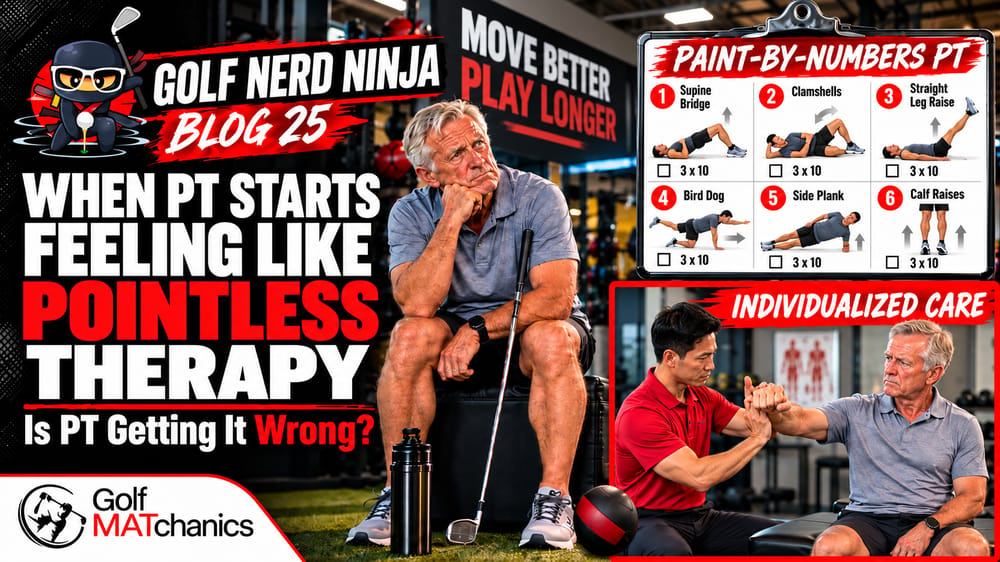
PAINT-BY-NUMBERS PT
Remember those paint-by-number kits when you were a kid?
Number one is blue.
Number two is red.
Number three is green.
Follow the numbers.
Stay inside the lines.
And eventually, you've got yourself a picture.
Now imagine that approach applied too rigidly to rehabilitation.
Follow the exercise sheet.
Check the boxes.
Move to the next patient.
Repeat.
That's what I mean by:
PAINT-BY-NUMBERS PT.
It's when rehabilitation feels like following a predetermined routine rather than a process that adapts to the person receiving it.
The distinction is important.
A structured program isn't necessarily a generic program.
And two people performing the same exercise doesn't prove they're receiving poor treatment.
The question is whether somebody is evaluating how those exercises fit each individual.
Are they reassessing?
Are they monitoring progress?
And are they adjusting the program when necessary?
Because here's what I want you to remember:
ARE WE FOLLOWING THE NUMBERS, OR PAYING ATTENTION TO THE PERSON HOLDING THE PAINTBRUSH?
The goal shouldn't be forcing the patient to fit the program.
The goal should be making sure the program fits the patient.
CLIENT STORY #1 — WHY HE CALLED IT POINTLESS THERAPY
Let me tell you about the client who inspired this episode.
He's undergone several surgeries over the years.
And when we started discussing his rehabilitation experiences, two stood out.
One involved his knee.
The other involved his shoulder.
And his perception of those experiences couldn't have been more different.
HIS ACL RECONSTRUCTION
After undergoing ACL reconstruction surgery, he began physical therapy.
Part of his rehabilitation involved restoring knee flexion.
That's the bending motion of the knee.
He described his therapist applying pressure to increase that range of motion.
And according to him, it was incredibly painful.
So painful, in fact, that he started adjusting his hip position to make it appear as though his knee was bending farther.
Why?
Because he wanted the therapist to stop pushing.
Now, I wasn't there.
I don't know exactly what stage of rehabilitation he was in, and I don't know the clinical reasoning behind those treatment decisions.
And restoring knee flexion can be an important part of ACL rehabilitation.
But the experience left him frustrated.
WHAT ABOUT HIS FOOT?
Here's where our conversation got interesting.
While he was still receiving physical therapy for his knee, we were also working together.
And one of the first areas I examined was his foot.
I wanted to understand the muscular relationship between:
Foot function and control
Internal and external tibial rotation
The muscular capabilities of his lower leg
How those components contributed to his knee
The knee may have its own joint mechanics, but it doesn't function independently of the foot and hip.
When I explained what I wanted to examine, he said something interesting.
He'd seen other physical therapists working on the foot with patients who'd undergone similar knee surgeries.
Then he asked:
"WHY DIDN'T MY PHYSICAL THERAPIST START WITH MY FOOT?"
And I jokingly responded:
"Well, at least we are!"
I explained that his physical therapist could continue managing his knee rehabilitation while we explored the muscular relationship involving his foot and lower leg, within his medical restrictions.
I wasn't trying to replace his rehabilitation.
I was looking at another component of his muscular system.
And there could have been perfectly appropriate reasons his physical therapist had different priorities at that stage.
But it opened a useful conversation about how different practitioners examine the same body.
THE SAME CLIENT. A COMPLETELY DIFFERENT PT EXPERIENCE.
Now, here's what made his story particularly interesting.
This same client had previously undergone shoulder reconstruction.
And he loved that physical therapy experience.
He remembered his therapists examining muscular functions throughout his shoulder girdle.
His pectoral muscles.
His deltoids.
His trapezius muscles.
His rotator cuff.
And scapular stability.
He felt they were evaluating the individual components of his shoulder and how those muscles contributed to movement and control.
From his perspective, the treatment felt detailed and individualized.
He wasn't simply thinking about increasing range of motion.
He felt the practitioners were examining the muscular system around the shoulder as a whole.
And that's the contrast that bothered him.
His shoulder rehabilitation felt comprehensive.
His knee rehabilitation felt more narrowly focused.
Now, we cannot conclude from those experiences alone that either treatment approach was inappropriate.
Different injuries and surgeries have different rehabilitation requirements.
But his perception matters because it highlights something important:
PATIENTS NEED TO UNDERSTAND WHY THEIR REHABILITATION IS STRUCTURED THE WAY IT IS.
Good communication can help patients understand the purpose of an exercise, why certain areas are being prioritized, and when their program may progress.
And that brings me to another client.
CLIENT STORY #2 — THE EXERCISES WEREN'T NECESSARILY WRONG
I have a female client in her 60s who's worked with me for years.
She injured her shoulder while playing pickleball and decided to pursue physical therapy.
After two or three sessions, she became frustrated.
She brought her exercise program to me.
Now, here's what I found interesting.
I didn't necessarily think her exercises were wrong.
Instead, I wanted to understand how those exercises matched her available muscular capabilities.
So we examined her shoulder.
How was it moving?
What ranges of motion were available?
Where was she having difficulty producing muscular force?
And how did she respond in different positions?
Then, within her medical restrictions, we began modifying how she performed certain exercises.
Different positions.
Different angles.
Different muscular demands.
We also continued using Muscle Activation Techniques™ to assess and work on individual muscular functions, followed by reassessment.
Over time, she reported that her shoulder discomfort began settling down.
Now, I can't claim MAT alone caused that improvement.
And her physical therapist may well have adjusted her exercise program as rehabilitation continued.
But here's the important lesson from our experience:
WE DIDN'T REINVENT THE EXERCISES.
WE INDIVIDUALIZED THEM TO HER.
Sometimes the exercise itself may be appropriate.
But the position, range, resistance, or progression may need adjusting.
That brings me to one of the biggest distinctions in how I approach training.
PROTOCOLS VS. PROCEDURES
THE STEPS CREATE CONSISTENCY.
THE RESULTS DETERMINE WHAT HAPPENS NEXT.
Let me start by saying that I understand the purpose of rehabilitation protocols.
Especially after surgery.
They provide important guidelines.
They establish precautions.
And they help practitioners respect healing timelines.
But personally, I prefer what I call an:
ASSESSMENT-DRIVEN PROCEDURAL APPROACH.
Here's what I mean.
When I think about a rigidly applied protocol, I think:
Step one.
Step two.
Step three.
Everyone follows the same path, regardless of their response.
But an assessment-driven procedure allows for structured decision-making.
The process becomes:
Assess: What can the individual currently do?
Identify: Which findings deserve attention?
Intervene: Apply an appropriate exercise or intervention.
Reassess: What changed, and how did the individual respond?
Adjust: Continue, modify, or reconsider the approach based on those results.
Now, protocols and procedures aren't mutually exclusive.
A well-designed clinical protocol can include exactly this kind of decision-making.
What concerns me is when a program becomes so rigid that the individual's response no longer influences what happens next.
Because the purpose of a system isn't to eliminate thinking.
It's to create a consistent way to make better decisions.
And interestingly, research on ACL rehabilitation supports the importance of individualized progression.
WHAT DOES THE RESEARCH SAY?
THE 2023 ASPETAR ACL REHABILITATION GUIDELINE
In 2023, the British Journal of Sports Medicine published the Aspetar Clinical Practice Guideline on Rehabilitation After ACL Reconstruction.
The guideline draws on available research and expert recommendations to provide direction for rehabilitation following ACL surgery.
Several principles are relevant to this discussion.
Rehabilitation should be individually prescribed and monitored.
Strength and motor control training are both important components.
And progression should consider physical criteria, not simply the number of weeks since surgery.
This is often described as:
CRITERIA-BASED PROGRESSION.
Consider three people recovering from ACL reconstruction.
Person one regains range of motion quickly but still has significant strength limitations.
Person two demonstrates reasonable strength but struggles with movement control.
Person three continues dealing with swelling that influences what they're able to do.
All three underwent similar surgeries.
But should they progress at exactly the same rate?
Not necessarily.
A criteria-based approach considers what each individual can demonstrate.
Range of motion.
Strength.
Movement control.
Swelling and symptoms.
And readiness for the next rehabilitation activity.
Of course, tissue healing, surgical restrictions, and clinical judgment remain essential.
The takeaway isn't that protocols are bad.
The guideline itself provides a framework for clinical decision-making.
And it certainly doesn't prove my client's physical therapist made an incorrect decision.
Instead, it illustrates a broader principle:
GUIDELINES PROVIDE DIRECTION.
ASSESSMENT PROVIDES INFORMATION.
REASSESSMENT HELPS DETERMINE THE NEXT STEP.
Although this guideline specifically addresses ACL rehabilitation, individualized monitoring and progression are important concepts across many forms of rehabilitation and exercise.
That's the connection I find most interesting.
The steps create consistency. The results determine what happens next.
COULD INSURANCE CHANGE THE PHYSICAL THERAPY EXPERIENCE?
Here's another question worth exploring.
Could the insurance system influence how physical therapy is delivered?
Insurance-based facilities have requirements involving:
Medical necessity and documentation
Prior authorizations, when applicable
Covered services and visit limitations
Reimbursement and administrative requirements
Those requirements can affect how a facility operates.
Could they influence appointment structure, scheduling, or staffing decisions?
Potentially.
I've had clients describe needing additional referrals or authorizations before certain treatment services were covered.
And that raises a question worth asking:
DOES THE PAYMENT MODEL AFFECT HOW MY REHABILITATION IS DELIVERED?
Now, there's an important clarification.
A physical therapist isn't automatically prohibited from evaluating the hip because the patient came in with back pain.
When clinically appropriate, examining related areas can be part of a comprehensive evaluation.
But whether an insurer covers particular services depends on the policy, documentation, applicable regulations, and medical necessity.
That distinction matters.
INSURANCE-BASED VS. CASH-BASED PT
Some physical therapists choose cash-based or out-of-network practices.
This may offer additional flexibility in appointment scheduling, visit length, or services provided.
But cash-based doesn't automatically mean better.
And insurance-based doesn't automatically mean worse.
There are excellent therapists in both models.
The important question is:
How does the facility operate, and what does that mean for the care I'll receive?
WHO IS ACTUALLY WORKING WITH YOU?
Here's something many patients may not fully understand when they begin physical therapy.
There are different professional roles involved in providing care.
PHYSICAL THERAPIST — PT
The licensed physical therapist performs the clinical evaluation, develops the treatment plan, and is responsible for the clinical decisions within that plan.
PHYSICAL THERAPIST ASSISTANT — PTA
A licensed physical therapist assistant provides treatment under the direction and supervision of a physical therapist.
PTAs can play an important role in treatment delivery, monitoring responses, and communicating progress.
PHYSICAL THERAPY AIDE
An aide provides limited support activities under applicable supervision requirements.
An aide is not independently responsible for evaluating patients, diagnosing conditions, or developing treatment plans.
Now, a team-based rehabilitation model can be extremely effective.
Being treated by a PTA doesn't automatically mean you're receiving lesser care.
But I think patients should understand the system.
Who's monitoring my progress?
Who's reassessing my condition?
Who can answer questions about my program?
And who's responsible for changing the treatment plan when necessary?
Because there's a difference between:
RECEIVING COORDINATED TEAM-BASED CARE
and
FEELING LIKE YOU'RE MOVING THROUGH AN ASSEMBLY LINE.
Communication, appropriate supervision, and individual monitoring matter.
WHAT DOES THIS MEAN FOR GOLFERS?
Let's bring this back to golf.
Whether you're recovering from surgery, dealing with an injury, or trying to stay active as you age, your rehabilitation goals matter.
Maybe you want to play 18 holes comfortably.
Maybe you're trying to return to strength training.
Maybe you want to play three rounds a week.
Or maybe you want to get through a golf season without repeatedly dealing with the same limitations.
Whatever your goal, it's important that the practitioner understands what you're trying to return to doing.
You don't necessarily need a physical therapist who specializes exclusively in golf.
But you do want somebody who considers the physical demands of your activities.
Think about a shoulder injury.
Getting your shoulder to feel better during daily activities is one meaningful milestone.
Returning to repeated golf swings, practice sessions, and the demands of playing a full round may require further progression.
And that progression should consider your individual recovery and medical restrictions.
Because:
FEELING BETTER AND BEING PREPARED FOR YOUR ACTIVITY ARE DIFFERENT QUESTIONS.
A thoughtful rehabilitation plan should help you understand both.
THREE QUESTIONS TO ASK BEFORE CHOOSING A PHYSICAL THERAPIST
You don't need to become a rehabilitation expert.
But you should understand who is helping you and how your care is being delivered.
Here are three questions I'd encourage every golfer to ask.
1. WHO IS ACTUALLY GOING TO WORK WITH ME?
Will my treatment primarily be provided by a physical therapist?
Will a licensed PTA be involved?
Will aides provide some supervised assistance?
And most importantly:
Who is responsible for evaluating my progress and making treatment decisions?
Understanding the team can help you know what to expect.
2. HOW WILL YOU INDIVIDUALIZE MY REHABILITATION?
Ask what the initial evaluation will involve.
How will progress be measured?
How frequently will the treatment plan be reassessed?
And what happens if an exercise isn't producing the desired response?
As a golfer, you can also ask:
"How will this program help me return to the physical demands of golf?"
That's a reasonable goal to discuss with your therapist.
3. HOW DOES YOUR FACILITY OPERATE?
Is the practice insurance-based, cash-based, or out-of-network?
How long are the appointments?
How much individual attention can I expect?
What services are covered?
And will I need authorizations or referrals?
These questions can help prevent confusion once rehabilitation begins.
Because ultimately:
YOU SHOULD UNDERSTAND THE PROCESS BEHIND YOUR CARE.
THREE TAKEAWAYS
1. ONE PT EXPERIENCE DOESN'T DEFINE THE ENTIRE PROFESSION.
Physical therapy can provide tremendous value.
There are excellent therapists helping patients recover from injuries, surgeries, and physical limitations every day.
A frustrating experience doesn't mean the profession itself is ineffective.
2. UNDERSTAND THE SYSTEM BEHIND YOUR REHABILITATION.
Insurance.
Staffing.
Protocols.
Appointment structure.
Communication.
All of these can influence your experience.
Ask questions so you understand how the facility operates and who is responsible for your care.
3. INDIVIDUALIZATION MATTERS.
Two people may share an injury diagnosis.
That doesn't mean their rehabilitation needs or responses will always be identical.
A good process includes appropriate assessment, intervention, monitoring, and reassessment.
Because:
THE EXERCISE MIGHT NOT BE WRONG.
IT MIGHT JUST NEED TO BE ADJUSTED TO THE PERSON PERFORMING IT.
READY TO TAKE THE NEXT STEP WITH YOUR GOLF BODY?
If you've been through physical therapy and your pain has decreased or even disappeared, that doesn't necessarily mean your journey is over.
At Golf MATchanics, we specialize in Muscle Activation Techniques™ and strength coaching for golfers.
We examine muscular function, look for potential weaknesses, and work toward improving muscular capabilities before progressing strength and capacity.
Our starting point is the:
BODY BLUEPRINT.
The Body BluePrint helps us understand your muscular system and determine whether MAT may be an appropriate next step for your golf body.
Golf MATchanics is located in Glenview, Illinois, serving golfers throughout Chicago's North Shore.
Explore the Body BluePrint
THE GOLF NERD NINJA BOTTOM LINE
So, is physical therapy getting it wrong?
I don't think it's that simple.
Physical therapy is a profession with tremendous potential to help people.
But the individual patient experience can vary.
A well-designed program should account for the patient's condition, abilities, goals, and response to treatment.
And if you're receiving physical therapy, you should feel comfortable asking how your program is being evaluated and progressed.
Remember my Paint-by-Numbers PT analogy?
Don't just follow the numbers.
PAY ATTENTION TO THE PERSON HOLDING THE PAINTBRUSH.
Because the goal isn't to force everyone through the same routine.
It's to provide appropriate, individualized care.
For us golfers, the bigger goal is simple.
Stay strong.
Stay resilient.
And keep playing the game we love well into our golden years.
THE SWING IS THE EXPRESSION.
THE BODY IS THE SYSTEM.
MUSCLE FUNCTION FIRST.
Are You Ready to Stop Guessing?
If your body does not feel like it is keeping up with your golf game, start here:
Take the Golf MATchanics™ Golf Body Test.
Want a deeper look at your body and your swing?
Learn more about the Body BluePrint.
Want to understand your strength, force, and golf-body performance? Learn more about the IMPACT BluePrint.
Ready to talk through the best starting point for you?
Book a 30-minute Golf MATchanics™ consultation.
Because golf longevity is not something you hope for.
It is something you build.
RESEARCH REFERENCE
Aspetar Clinical Practice Guideline on Rehabilitation After Anterior Cruciate Ligament Reconstruction
Published in the British Journal of Sports Medicine, 2023.
https://bjsm.bmj.com/content/57/9/500
The guideline discusses individualized rehabilitation, monitoring, strength and motor control training, and criteria-based progression. Its recommendations are specific to ACL reconstruction; the broader application to other forms of rehabilitation in this article is an interpretation, not a finding that every PT treatment should follow the same ACL guideline.
When PT Starts Feeling Like Pointless Therapy: Is PT Getting It Wrong?
Monday, October 19, 2026
I had a client say something recently that cracked me up.
He looked at me and said: "PT? YOU MEAN POINTLESS THERAPY?"
Now, that's a pretty bold statement.
And before all the physical therapists reading this start getting upset, let me make something clear.
I'm not a physical therapist, and I'm not here to criticize the profession.
Physical therapy can be incredibly valuable, especially when someone is recovering from surgery or an injury.
But after decades of working with clients, I've heard some interesting stories about their rehabilitation experiences.
Some absolutely love their physical therapists.
Others feel like they're getting pushed through the same exercises week after week.
And that raises a question worth exploring:
WHY CAN TWO PHYSICAL THERAPY FACILITIES PROVIDE SUCH DIFFERENT EXPERIENCES?
Is it the therapist?
The protocol?
The facility's business model?
Or the overall approach?
And more importantly:
How do you know whether the rehabilitation you're receiving is appropriate for you?
Let's get into it.
THE GOLFER'S MYTH
"IF I'M GOING TO PHYSICAL THERAPY, I'M GETTING THE RIGHT TREATMENT."
You hurt your shoulder?
Here's your rotator cuff exercises.
You hurt your knee?
Here's your exercise sheet.
Three sets of ten.
Next patient!
Okay, I'm exaggerating a little.
And I'm certainly not suggesting that every physical therapist works this way.
But I've heard versions of this experience from clients.
The problem with that thinking is simple.
Two people can have similar injuries without having identical physical capabilities.
They may not move the same way.
They may not produce muscular force the same way.
And they may not respond to an exercise the same way.
That doesn't mean standardized rehabilitation exercises are wrong.
In fact, many are supported by research and serve an important purpose.
But the selection, progression, and modification of those exercises should consider the individual.
Which brings me to something I call:
PAINT-BY-NUMBERS PT
Remember those paint-by-number kits when you were a kid?
Number one is blue.
Number two is red.
Number three is green.
Follow the numbers.
Stay inside the lines.
And eventually, you've got yourself a picture.
Now imagine that approach applied too rigidly to rehabilitation.
Follow the exercise sheet.
Check the boxes.
Move to the next patient.
Repeat.
That's what I mean by:
PAINT-BY-NUMBERS PT.
It's when rehabilitation feels like following a predetermined routine rather than a process that adapts to the person receiving it.
The distinction is important.
A structured program isn't necessarily a generic program.
And two people performing the same exercise doesn't prove they're receiving poor treatment.
The question is whether somebody is evaluating how those exercises fit each individual.
Are they reassessing?
Are they monitoring progress?
And are they adjusting the program when necessary?
Because here's what I want you to remember:
ARE WE FOLLOWING THE NUMBERS, OR PAYING ATTENTION TO THE PERSON HOLDING THE PAINTBRUSH?
The goal shouldn't be forcing the patient to fit the program.
The goal should be making sure the program fits the patient.
CLIENT STORY #1 — WHY HE CALLED IT POINTLESS THERAPY
Let me tell you about the client who inspired this episode.
He's undergone several surgeries over the years.
And when we started discussing his rehabilitation experiences, two stood out.
One involved his knee.
The other involved his shoulder.
And his perception of those experiences couldn't have been more different.
HIS ACL RECONSTRUCTION
After undergoing ACL reconstruction surgery, he began physical therapy.
Part of his rehabilitation involved restoring knee flexion.
That's the bending motion of the knee.
He described his therapist applying pressure to increase that range of motion.
And according to him, it was incredibly painful.
So painful, in fact, that he started adjusting his hip position to make it appear as though his knee was bending farther.
Why?
Because he wanted the therapist to stop pushing.
Now, I wasn't there.
I don't know exactly what stage of rehabilitation he was in, and I don't know the clinical reasoning behind those treatment decisions.
And restoring knee flexion can be an important part of ACL rehabilitation.
But the experience left him frustrated.
WHAT ABOUT HIS FOOT?
Here's where our conversation got interesting.
While he was still receiving physical therapy for his knee, we were also working together.
And one of the first areas I examined was his foot.
I wanted to understand the muscular relationship between:
Foot function and control
Internal and external tibial rotation
The muscular capabilities of his lower leg
How those components contributed to his knee
The knee may have its own joint mechanics, but it doesn't function independently of the foot and hip.
When I explained what I wanted to examine, he said something interesting.
He'd seen other physical therapists working on the foot with patients who'd undergone similar knee surgeries.
Then he asked:
"WHY DIDN'T MY PHYSICAL THERAPIST START WITH MY FOOT?"
And I jokingly responded:
"Well, at least we are!"
I explained that his physical therapist could continue managing his knee rehabilitation while we explored the muscular relationship involving his foot and lower leg, within his medical restrictions.
I wasn't trying to replace his rehabilitation.
I was looking at another component of his muscular system.
And there could have been perfectly appropriate reasons his physical therapist had different priorities at that stage.
But it opened a useful conversation about how different practitioners examine the same body.
THE SAME CLIENT. A COMPLETELY DIFFERENT PT EXPERIENCE.
Now, here's what made his story particularly interesting.
This same client had previously undergone shoulder reconstruction.
And he loved that physical therapy experience.
He remembered his therapists examining muscular functions throughout his shoulder girdle.
His pectoral muscles.
His deltoids.
His trapezius muscles.
His rotator cuff.
And scapular stability.
He felt they were evaluating the individual components of his shoulder and how those muscles contributed to movement and control.
From his perspective, the treatment felt detailed and individualized.
He wasn't simply thinking about increasing range of motion.
He felt the practitioners were examining the muscular system around the shoulder as a whole.
And that's the contrast that bothered him.
His shoulder rehabilitation felt comprehensive.
His knee rehabilitation felt more narrowly focused.
Now, we cannot conclude from those experiences alone that either treatment approach was inappropriate.
Different injuries and surgeries have different rehabilitation requirements.
But his perception matters because it highlights something important:
PATIENTS NEED TO UNDERSTAND WHY THEIR REHABILITATION IS STRUCTURED THE WAY IT IS.
Good communication can help patients understand the purpose of an exercise, why certain areas are being prioritized, and when their program may progress.
And that brings me to another client.
CLIENT STORY #2 — THE EXERCISES WEREN'T NECESSARILY WRONG
I have a female client in her 60s who's worked with me for years.
She injured her shoulder while playing pickleball and decided to pursue physical therapy.
After two or three sessions, she became frustrated.
She brought her exercise program to me.
Now, here's what I found interesting.
I didn't necessarily think her exercises were wrong.
Instead, I wanted to understand how those exercises matched her available muscular capabilities.
So we examined her shoulder.
How was it moving?
What ranges of motion were available?
Where was she having difficulty producing muscular force?
And how did she respond in different positions?
Then, within her medical restrictions, we began modifying how she performed certain exercises.
Different positions.
Different angles.
Different muscular demands.
We also continued using Muscle Activation Techniques™ to assess and work on individual muscular functions, followed by reassessment.
Over time, she reported that her shoulder discomfort began settling down.
Now, I can't claim MAT alone caused that improvement.
And her physical therapist may well have adjusted her exercise program as rehabilitation continued.
But here's the important lesson from our experience:
WE DIDN'T REINVENT THE EXERCISES.
WE INDIVIDUALIZED THEM TO HER.
Sometimes the exercise itself may be appropriate.
But the position, range, resistance, or progression may need adjusting.
That brings me to one of the biggest distinctions in how I approach training.
PROTOCOLS VS. PROCEDURES
THE STEPS CREATE CONSISTENCY.
THE RESULTS DETERMINE WHAT HAPPENS NEXT.
Let me start by saying that I understand the purpose of rehabilitation protocols.
Especially after surgery.
They provide important guidelines.
They establish precautions.
And they help practitioners respect healing timelines.
But personally, I prefer what I call an:
ASSESSMENT-DRIVEN PROCEDURAL APPROACH.
Here's what I mean.
When I think about a rigidly applied protocol, I think:
Step one.
Step two.
Step three.
Everyone follows the same path, regardless of their response.
But an assessment-driven procedure allows for structured decision-making.
The process becomes:
Assess: What can the individual currently do?
Identify: Which findings deserve attention?
Intervene: Apply an appropriate exercise or intervention.
Reassess: What changed, and how did the individual respond?
Adjust: Continue, modify, or reconsider the approach based on those results.
Now, protocols and procedures aren't mutually exclusive.
A well-designed clinical protocol can include exactly this kind of decision-making.
What concerns me is when a program becomes so rigid that the individual's response no longer influences what happens next.
Because the purpose of a system isn't to eliminate thinking.
It's to create a consistent way to make better decisions.
And interestingly, research on ACL rehabilitation supports the importance of individualized progression.
WHAT DOES THE RESEARCH SAY?
THE 2023 ASPETAR ACL REHABILITATION GUIDELINE
In 2023, the British Journal of Sports Medicine published the Aspetar Clinical Practice Guideline on Rehabilitation After ACL Reconstruction.
The guideline draws on available research and expert recommendations to provide direction for rehabilitation following ACL surgery.
Several principles are relevant to this discussion.
Rehabilitation should be individually prescribed and monitored.
Strength and motor control training are both important components.
And progression should consider physical criteria, not simply the number of weeks since surgery.
This is often described as:
CRITERIA-BASED PROGRESSION.
Consider three people recovering from ACL reconstruction.
Person one regains range of motion quickly but still has significant strength limitations.
Person two demonstrates reasonable strength but struggles with movement control.
Person three continues dealing with swelling that influences what they're able to do.
All three underwent similar surgeries.
But should they progress at exactly the same rate?
Not necessarily.
A criteria-based approach considers what each individual can demonstrate.
Range of motion.
Strength.
Movement control.
Swelling and symptoms.
And readiness for the next rehabilitation activity.
Of course, tissue healing, surgical restrictions, and clinical judgment remain essential.
The takeaway isn't that protocols are bad.
The guideline itself provides a framework for clinical decision-making.
And it certainly doesn't prove my client's physical therapist made an incorrect decision.
Instead, it illustrates a broader principle:
GUIDELINES PROVIDE DIRECTION.
ASSESSMENT PROVIDES INFORMATION.
REASSESSMENT HELPS DETERMINE THE NEXT STEP.
Although this guideline specifically addresses ACL rehabilitation, individualized monitoring and progression are important concepts across many forms of rehabilitation and exercise.
That's the connection I find most interesting.
The steps create consistency. The results determine what happens next.
COULD INSURANCE CHANGE THE PHYSICAL THERAPY EXPERIENCE?
Here's another question worth exploring.
Could the insurance system influence how physical therapy is delivered?
Insurance-based facilities have requirements involving:
Medical necessity and documentation
Prior authorizations, when applicable
Covered services and visit limitations
Reimbursement and administrative requirements
Those requirements can affect how a facility operates.
Could they influence appointment structure, scheduling, or staffing decisions?
Potentially.
I've had clients describe needing additional referrals or authorizations before certain treatment services were covered.
And that raises a question worth asking:
DOES THE PAYMENT MODEL AFFECT HOW MY REHABILITATION IS DELIVERED?
Now, there's an important clarification.
A physical therapist isn't automatically prohibited from evaluating the hip because the patient came in with back pain.
When clinically appropriate, examining related areas can be part of a comprehensive evaluation.
But whether an insurer covers particular services depends on the policy, documentation, applicable regulations, and medical necessity.
That distinction matters.
INSURANCE-BASED VS. CASH-BASED PT
Some physical therapists choose cash-based or out-of-network practices.
This may offer additional flexibility in appointment scheduling, visit length, or services provided.
But cash-based doesn't automatically mean better.
And insurance-based doesn't automatically mean worse.
There are excellent therapists in both models.
The important question is:
How does the facility operate, and what does that mean for the care I'll receive?
WHO IS ACTUALLY WORKING WITH YOU?
Here's something many patients may not fully understand when they begin physical therapy.
There are different professional roles involved in providing care.
PHYSICAL THERAPIST — PT
The licensed physical therapist performs the clinical evaluation, develops the treatment plan, and is responsible for the clinical decisions within that plan.
PHYSICAL THERAPIST ASSISTANT — PTA
A licensed physical therapist assistant provides treatment under the direction and supervision of a physical therapist.
PTAs can play an important role in treatment delivery, monitoring responses, and communicating progress.
PHYSICAL THERAPY AIDE
An aide provides limited support activities under applicable supervision requirements.
An aide is not independently responsible for evaluating patients, diagnosing conditions, or developing treatment plans.
Now, a team-based rehabilitation model can be extremely effective.
Being treated by a PTA doesn't automatically mean you're receiving lesser care.
But I think patients should understand the system.
Who's monitoring my progress?
Who's reassessing my condition?
Who can answer questions about my program?
And who's responsible for changing the treatment plan when necessary?
Because there's a difference between:
RECEIVING COORDINATED TEAM-BASED CARE
and
FEELING LIKE YOU'RE MOVING THROUGH AN ASSEMBLY LINE.
Communication, appropriate supervision, and individual monitoring matter.
WHAT DOES THIS MEAN FOR GOLFERS?
Let's bring this back to golf.
Whether you're recovering from surgery, dealing with an injury, or trying to stay active as you age, your rehabilitation goals matter.
Maybe you want to play 18 holes comfortably.
Maybe you're trying to return to strength training.
Maybe you want to play three rounds a week.
Or maybe you want to get through a golf season without repeatedly dealing with the same limitations.
Whatever your goal, it's important that the practitioner understands what you're trying to return to doing.
You don't necessarily need a physical therapist who specializes exclusively in golf.
But you do want somebody who considers the physical demands of your activities.
Think about a shoulder injury.
Getting your shoulder to feel better during daily activities is one meaningful milestone.
Returning to repeated golf swings, practice sessions, and the demands of playing a full round may require further progression.
And that progression should consider your individual recovery and medical restrictions.
Because:
FEELING BETTER AND BEING PREPARED FOR YOUR ACTIVITY ARE DIFFERENT QUESTIONS.
A thoughtful rehabilitation plan should help you understand both.
THREE QUESTIONS TO ASK BEFORE CHOOSING A PHYSICAL THERAPIST
You don't need to become a rehabilitation expert.
But you should understand who is helping you and how your care is being delivered.
Here are three questions I'd encourage every golfer to ask.
1. WHO IS ACTUALLY GOING TO WORK WITH ME?
Will my treatment primarily be provided by a physical therapist?
Will a licensed PTA be involved?
Will aides provide some supervised assistance?
And most importantly:
Who is responsible for evaluating my progress and making treatment decisions?
Understanding the team can help you know what to expect.
2. HOW WILL YOU INDIVIDUALIZE MY REHABILITATION?
Ask what the initial evaluation will involve.
How will progress be measured?
How frequently will the treatment plan be reassessed?
And what happens if an exercise isn't producing the desired response?
As a golfer, you can also ask:
"How will this program help me return to the physical demands of golf?"
That's a reasonable goal to discuss with your therapist.
3. HOW DOES YOUR FACILITY OPERATE?
Is the practice insurance-based, cash-based, or out-of-network?
How long are the appointments?
How much individual attention can I expect?
What services are covered?
And will I need authorizations or referrals?
These questions can help prevent confusion once rehabilitation begins.
Because ultimately:
YOU SHOULD UNDERSTAND THE PROCESS BEHIND YOUR CARE.
THREE TAKEAWAYS
1. ONE PT EXPERIENCE DOESN'T DEFINE THE ENTIRE PROFESSION.
Physical therapy can provide tremendous value.
There are excellent therapists helping patients recover from injuries, surgeries, and physical limitations every day.
A frustrating experience doesn't mean the profession itself is ineffective.
2. UNDERSTAND THE SYSTEM BEHIND YOUR REHABILITATION.
Insurance.
Staffing.
Protocols.
Appointment structure.
Communication.
All of these can influence your experience.
Ask questions so you understand how the facility operates and who is responsible for your care.
3. INDIVIDUALIZATION MATTERS.
Two people may share an injury diagnosis.
That doesn't mean their rehabilitation needs or responses will always be identical.
A good process includes appropriate assessment, intervention, monitoring, and reassessment.
Because:
THE EXERCISE MIGHT NOT BE WRONG.
IT MIGHT JUST NEED TO BE ADJUSTED TO THE PERSON PERFORMING IT.
READY TO TAKE THE NEXT STEP WITH YOUR GOLF BODY?
If you've been through physical therapy and your pain has decreased or even disappeared, that doesn't necessarily mean your journey is over.
At Golf MATchanics, we specialize in Muscle Activation Techniques™ and strength coaching for golfers.
We examine muscular function, look for potential weaknesses, and work toward improving muscular capabilities before progressing strength and capacity.
Our starting point is the:
BODY BLUEPRINT.
The Body BluePrint helps us understand your muscular system and determine whether MAT may be an appropriate next step for your golf body.
Golf MATchanics is located in Glenview, Illinois, serving golfers throughout Chicago's North Shore.
Explore the Body BluePrint
THE GOLF NERD NINJA BOTTOM LINE
So, is physical therapy getting it wrong?
I don't think it's that simple.
Physical therapy is a profession with tremendous potential to help people.
But the individual patient experience can vary.
A well-designed program should account for the patient's condition, abilities, goals, and response to treatment.
And if you're receiving physical therapy, you should feel comfortable asking how your program is being evaluated and progressed.
Remember my Paint-by-Numbers PT analogy?
Don't just follow the numbers.
PAY ATTENTION TO THE PERSON HOLDING THE PAINTBRUSH.
Because the goal isn't to force everyone through the same routine.
It's to provide appropriate, individualized care.
For us golfers, the bigger goal is simple.
Stay strong.
Stay resilient.
And keep playing the game we love well into our golden years.
THE SWING IS THE EXPRESSION.
THE BODY IS THE SYSTEM.
MUSCLE FUNCTION FIRST.
Are You Ready to Stop Guessing?
If your body does not feel like it is keeping up with your golf game, start here:
Take the Golf MATchanics™ Golf Body Test.
Want a deeper look at your body and your swing?
Learn more about the Body BluePrint.
Want to understand your strength, force, and golf-body performance? Learn more about the IMPACT BluePrint.
Ready to talk through the best starting point for you?
Book a 30-minute Golf MATchanics™ consultation.
Because golf longevity is not something you hope for.
It is something you build.
RESEARCH REFERENCE
Aspetar Clinical Practice Guideline on Rehabilitation After Anterior Cruciate Ligament Reconstruction
Published in the British Journal of Sports Medicine, 2023.
https://bjsm.bmj.com/content/57/9/500
The guideline discusses individualized rehabilitation, monitoring, strength and motor control training, and criteria-based progression. Its recommendations are specific to ACL reconstruction; the broader application to other forms of rehabilitation in this article is an interpretation, not a finding that every PT treatment should follow the same ACL guideline.